Loading song
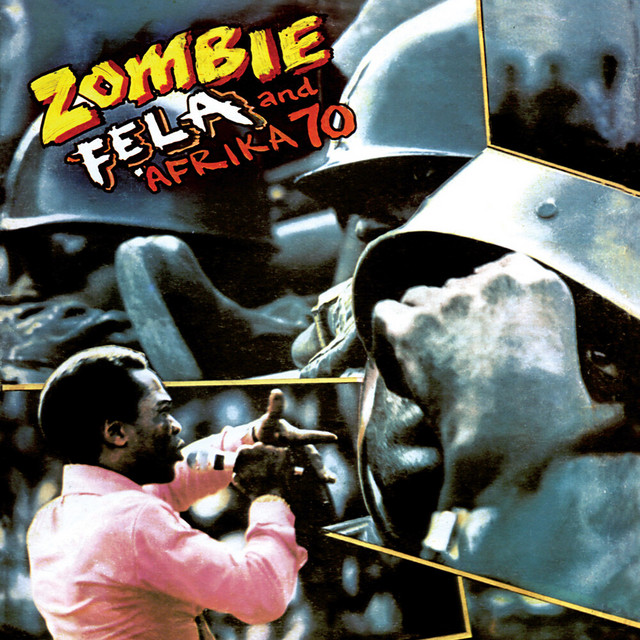
Song preview
Listen on


Quick Meaning
In 'Zombie,' Fela Kuti critiques the mindless obedience of soldiers, portraying them as zombies who only act on commands. The song's repetitive structure emphasizes the loss of individual agency in the face of authoritarian control.
- frustration
- urgency
- defiance
- critique
Metadata
- Year
- 1976
- Album
- Zombie
- Genre
- Afro-Beat
- Unique visits
- 13
- Generated at
- May 21, 2026
- Updated at
- Oct 06, 2026
Meaning
Main Meaning
itsMong interpretation
Fela Kuti's 'Zombie' starkly illustrates the dehumanization of soldiers who act without thought or autonomy, as shown in the lines 'Zombie no go go, unless you tell am to go' and 'Zombie no go think, unless you tell am to think.'
This repetition underscores the critique of a system that reduces individuals to mere instruments of power, devoid of personal agency and critical thinking.
Title Analysis
The title 'Zombie' refers to individuals who lack independent thought and action, as emphasized in the repeated lyric 'Zombie no go go, unless you tell am to go.'
This encapsulates the central theme of the song, which critiques the mindless obedience of soldiers under authoritarian regimes.
Deeper Insight
The song's portrayal of soldiers as zombies reveals a deeper societal critique of how authoritarian regimes strip individuals of their humanity.
This dynamic reflects broader themes of conformity and the dangers of uncritical obedience in any societal structure.
Emotional Impact
Listeners may feel a sense of urgency and frustration at the depiction of mindless obedience, prompting reflection on the importance of critical thinking and individual agency.
Song Takeaway
The song serves as a reminder of the importance of questioning authority and maintaining one's individuality in the face of oppressive systems.
Key Lines
"Zombie no go go, unless you tell am to go"
This line highlights the lack of agency among soldiers, emphasizing their dependence on commands.
"Zombie no go stop, unless you tell am to stop"
Reinforces the idea of mindless obedience, where actions are dictated by external orders.
"Zombie no go think, unless you tell am to think"
Illustrates the absence of critical thought, portraying individuals as mere puppets.
"Tell them to go kill, a joro, jara, joro"
Suggests the dangerous implications of blind obedience, where soldiers are commanded to commit violence.
"Attention! Quick march!"
The military commands symbolize the rigid structure of authority that dictates behavior.
"No break, no job, no sense, a joro, jara, joro"
Critiques the futility of the soldiers' existence, highlighting a lack of purpose beyond following orders.
"Go and die! (Joro, jaro, joro)"
This line starkly illustrates the extreme consequences of blind obedience, where life is expendable.
"Zombie wey na one way"
Emphasizes the singular, unthinking path that soldiers follow, devoid of personal choice.
"Fall in! Fall out!"
Represents the rigid discipline of military life, further illustrating the theme of control.
"Put am for reverse!"
Symbolizes the lack of direction and autonomy, as soldiers are directed to act without understanding.
Explore a question
What does the title add?
The title 'Zombie' refers to individuals who lack independent thought and action, as emphasized in the repeated lyric 'Zombie no go go, unless you tell am to go.' This encapsulates the central theme of the song, which critiques the mindless obedience of soldiers under authoritarian regimes.
What does this key detail suggest?
Zombie no go go, unless you tell am to go
This line highlights the lack of agency among soldiers, emphasizing their dependence on commands.
What deeper tension appears?
The song's portrayal of soldiers as zombies reveals a deeper societal critique of how authoritarian regimes strip individuals of their humanity. This dynamic reflects broader themes of conformity and the dangers of uncritical obedience in any societal structure.
Public Perception
The song is widely recognized as a powerful political statement and has influenced many artists.
Song insights
Emotion Profile
A reading of the song's emotional signals, derived from its saved interpretation.
Emotional intensityHigh
Strong critique of blind obedience in lyrics.
VulnerabilityHigh
Reflects the loss of individual agency.
PrideModerate
Pride in cultural identity and resistance.
Emotional dependencyModerate
Dependence on authority for direction.
Levels describe how strongly a signal appears in this reading of the song; they do not measure the listener.
Mong DNA
Recurring themes and motifs identified in the saved interpretation.
What is Mong DNA?Loading...
Loading...
Comments & reviews
What moved you? Share your take on the lyrics, the sound or a moment this song reminds you of.
Sign in to comment.
Start the conversation. What would you tell someone hearing this song for the first time?
Rate this song
Lyrics
Optional — choose one to five stars.
Instrumental
Optional — choose one to five stars.
Emotional impact
Optional — choose one to five stars.
Overall
Optional — choose one to five stars.
Community rating